
Back pain is the second most common reason Americans visit a doctor — and most people don’t realise there’s a drug-free, surgery-free option that works at the structural level of the spine.
Flexion-distraction therapy is one of the most widely used techniques in chiropractic care today, and for good reason. It targets the root cause of disc-related pain rather than just masking symptoms. Chiropractors like those at Oviedo Chiropractic use this technique as a cornerstone treatment for patients dealing with everything from herniated discs to post-surgical recovery. If you’ve been told your only options are medication or an operation, this article will show you why that might not be true.

Flexion-distraction therapy is a specialised chiropractic technique that uses a segmented, moving treatment table to gently stretch and flex the spine in a slow, rhythmic motion. Unlike traditional chiropractic adjustments that use direct force or thrusting, this method applies no forceful manipulation at all. The table itself does most of the work, creating controlled, targeted movement through specific spinal segments.
The technique was developed to decompress spinal discs — the cushion-like structures sitting between each vertebra. When those discs become compressed through injury, poor posture, or degeneration, they can bulge, herniate, or press on nearby nerves. Flexion-distraction addresses this directly by opening up the spaces between vertebrae and allowing discs to shift back toward their natural position.
What makes this approach stand out is its gentleness. Patients don’t experience the cracking or popping associated with traditional adjustments. Instead, the table moves in a smooth, wave-like pattern that most people find deeply relaxing — even therapeutic in itself.
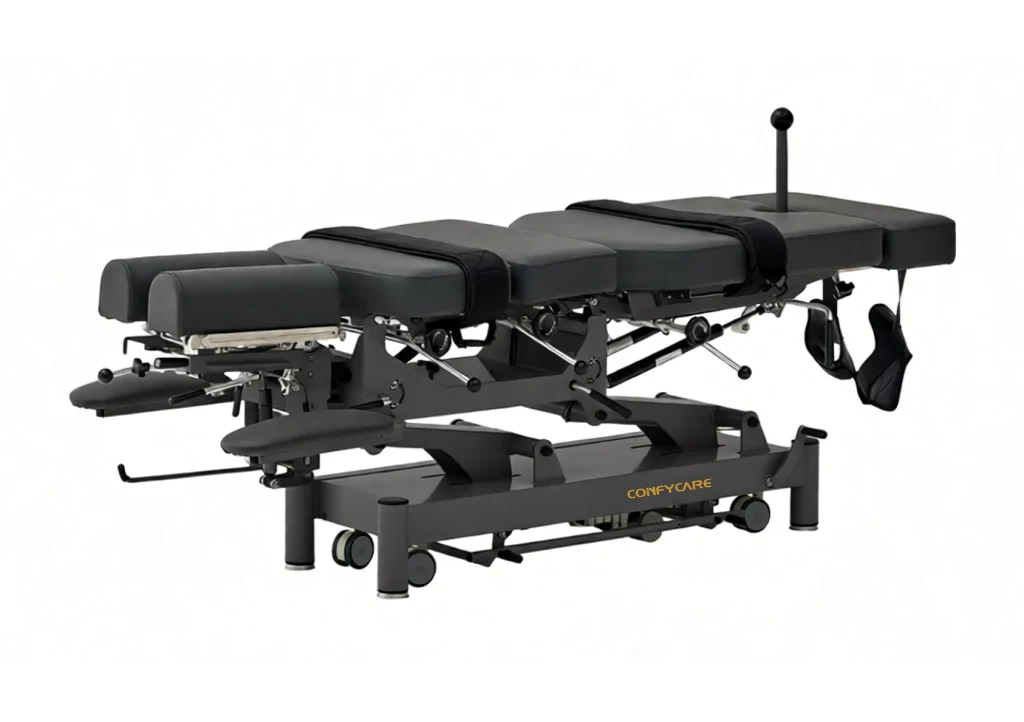
The flexion-distraction table is unlike any standard treatment table. It is divided into multiple sections that can move independently — flexing, extending, and laterally bending to guide the spine through controlled ranges of motion. The chiropractor manually guides specific spinal segments while the table moves beneath the patient, allowing precision targeting of problem areas without any jarring force. This combination of table movement and hands-on guidance is what makes the technique both safe and highly specific.
As the table stretches the spine, it creates negative intradiscal pressure — essentially a vacuum effect inside the disc. This negative pressure serves two critical functions. First, it draws the bulging or herniated disc material back toward the centre, away from the nerve it may be compressing. Second, it pulls in oxygen, fluids, and nutrients that the disc needs to heal, since spinal discs have a very limited blood supply and depend on this kind of pumping motion for nourishment.
Standard chiropractic adjustments use high-velocity, low-amplitude thrusting to restore joint mobility. Flexion-distraction uses low-velocity, sustained motion — no thrusting involved. This makes it appropriate for patients who cannot tolerate traditional adjustments, including those recovering from spinal surgery, individuals with osteoporosis, or anyone with an acute disc herniation, where sudden movement could worsen the condition.
The spine is made up of 33 vertebrae stacked on top of one another, with intervertebral discs acting as shock absorbers between them. When those discs compress — whether from prolonged sitting, heavy lifting, injury, or simple ageing — the results can range from dull aching to sharp, radiating nerve pain down the legs or arms. Flexion-distraction works by mechanically reversing that compression, one spinal segment at a time.
During a session, the patient lies face down on the flexion-distraction table while the chiropractor identifies the affected spinal level. As the table’s lower section drops and flexes, the targeted disc space widens — a measurable increase in the gap between spinous processes. This widening reduces intradiscal pressure and allows the disc to decompress. Research published in clinical studies confirms that this technique accurately decompresses the sites of lesions while gently stretching specific parts of the intervertebral discs, reducing both structural compression and associated pain signals.
When a disc herniates, it doesn’t just cause local back pain — it can press directly on spinal nerve roots, creating radiating pain, numbness, or tingling that travels down the arms or legs. Flexion-distraction relieves this by creating space within the spinal canal itself. As the vertebrae separate during treatment, the foramina — the small openings through which nerve roots exit the spine — widen, reducing pressure on those nerves. Patients often notice improvement in referred pain and limb symptoms within just a few sessions as nerve compression eases.
Flexion-distraction is not a one-size-fits-all treatment, but its range of applications is impressively broad. The common thread is that all of these conditions involve some form of disc compression, nerve impingement, or restricted spinal joint mobility — exactly what this technique is designed to address.
It is currently used in more than 50% of chiropractic clinical treatments, reflecting how versatile and effective practitioners have found it across a wide patient population. Whether the problem is structural, degenerative, or the result of trauma, flexion-distraction offers a pathway to relief that doesn’t involve pharmaceuticals or invasive procedures.
A herniated disc occurs when the soft inner core of a spinal disc pushes through its tougher outer shell, often pressing against a nearby nerve root. A prolapsed disc is a more advanced version of the same problem, where the disc material has shifted further out of position. A clinical study involving 30 female patients with lumbar intervertebral disc herniation found that both flexion-distraction combined with drop techniques and spinal decompression therapy effectively lowered pressure within the intervertebral discs. Both groups were treated three times per week over eight weeks, with measurable improvements in disc pressure and pain levels — confirming flexion-distraction as a clinically validated option for herniation management.
Spinal stenosis happens when the spinal canal — the channel running through your vertebrae that houses the spinal cord — becomes too narrow. This narrowing puts direct pressure on the spinal cord and nerve roots, causing pain, weakness, and that characteristic cramping sensation in the legs when walking. Flexion-distraction directly addresses this by mechanically widening the canal space during each treatment cycle. As the vertebrae separate and the disc spaces open, the canal itself gains room, reducing the crowding that causes nerve irritation.
Flexion-distraction stands out among chiropractic techniques because of who it can safely treat. After spinal surgery, the surrounding tissues are fragile, scar tissue is forming, and high-force manipulation is completely off the table. Flexion-distraction’s no-thrust, gentle approach makes it one of the only manual therapies appropriate during post-surgical recovery. The same logic applies to patients with osteoporosis — reduced bone density means standard adjustments carry real fracture risk, but the controlled, low-force motion of flexion-distraction eliminates that concern, giving these patients access to hands-on spinal care that would otherwise be unavailable to them.
The benefits of flexion-distraction go well beyond simple pain relief. Because it works at a structural and physiological level, the positive effects ripple outward into how you move, how your nerves function, and even how you stand. Here is a breakdown of the seven most significant benefits patients consistently experience.
This is the most immediate and clinically significant benefit. By creating negative intradiscal pressure during treatment, flexion-distraction actively pulls compressed disc material away from nerve tissue. The disc space literally widens as the spinous processes separate during the flexion cycle. For patients who have been dealing with chronic disc compression, this pressure reduction often produces noticeable relief within the first few sessions — sometimes even during the session itself.
As the vertebrae separate during treatment, the spinal canal gains measurable space. This is particularly significant for patients with stenosis or disc bulges that have been encroaching on the canal. More space means less pressure on the spinal cord and nerve roots running through it.
This widening effect is not permanent after a single session, but with consistent treatment, the cumulative structural changes — reduced disc bulging, improved disc hydration, and reduced inflammation — contribute to lasting improvements in canal diameter and nerve root clearance.
Spinal joints that have been compressed and restricted don’t move freely — and that limited motion spreads further than most people realise. Tight, compressed lumbar joints affect how the hips move. Restricted cervical segments change shoulder mechanics. Flexion-distraction restores proper joint mobility at each spinal level, and patients regularly report improved range of motion not just in their spine, but in their arms, legs, and shoulders as well.
This makes flexion-distraction particularly valuable for athletes or physically active individuals who have noticed a gradual reduction in flexibility or mobility that they’ve mistakenly attributed purely to ageing or muscle tightness.
When compressed nerves finally get the space they need, the downstream effects are significant. Radiating pain, numbness, and tingling in the extremities — all classic signs of nerve compression — begin to resolve as the mechanical pressure causing them is reduced. Flexion-distraction targets this directly by widening the intervertebral foramina, the openings through which nerve roots exit the spine, giving those nerves room to function without irritation.
Spinal discs are avascular — they have no direct blood supply of their own. They depend entirely on the diffusion of nutrients and fluids driven by movement and pressure changes. The rhythmic pumping motion of flexion-distraction is almost perfectly designed to stimulate this process, drawing nutrient-rich fluid into the disc during each decompression cycle.
This improved circulation doesn’t just benefit the discs. The surrounding soft tissues — muscles, ligaments, and joint capsules — also receive increased blood flow during treatment, accelerating the removal of inflammatory byproducts and supporting tissue repair throughout the treated region.
Chronic nerve compression doesn’t just cause pain — it disrupts the electrical signalling that travels between your brain and body. Muscles may weaken, reflexes may slow, and coordination can suffer as compressed nerves fail to transmit signals efficiently. By consistently reducing that compression, flexion-distraction allows nerve pathways to recover and restore normal communication.
Patients often notice this as improved strength in previously weak limbs, return of sensation in numb areas, or simply a feeling that their body is responding more normally to movement. These neurological improvements tend to build progressively over a course of treatment rather than appearing all at once.
Compressed discs and restricted spinal joints force the body into compensatory postures — the forward lean, the tilted pelvis, the rounded shoulders that develop as the spine tries to offload pressure from painful areas. As flexion-distraction restores proper disc height and joint mobility, the body no longer needs those compensations. Patients consistently report standing taller and moving more naturally as their treatment progresses, with postural improvements that extend well beyond the treatment table.
Your first flexion-distraction session typically begins with a brief assessment where the chiropractor identifies which spinal levels are involved and how much mobility is currently restricted. You’ll lie face down on the specialised segmented table, fully clothed, while the chiropractor positions themselves at the lower section of the table. From there, the table begins its controlled flexion and lateral movement while the chiropractor applies light manual contact to the targeted spinal segment — guiding the motion and monitoring your response in real time.
Sessions generally last between 10 and 20 minutes, depending on the condition being treated and how many spinal levels need attention. There is no sudden movement, no cracking, and no forceful pressure applied at any point. Most patients are surprised by how passive the experience feels — the table and the practitioner do all the work while you simply relax and let the spine respond to the decompression. Some patients even fall asleep during treatment, which is a reasonable indicator of just how non-threatening the process is.
The rhythmic, wave-like motion of the flexion-distraction table has a naturally calming effect on the nervous system. Rather than bracing for a forceful adjustment, patients experience a slow, repetitive stretching motion that signals safety rather than threat to the body. This matters clinically — when the body is relaxed, spinal muscles release their guarding tension, allowing the disc and joint decompression to be far more effective. Patients at practices like Oviedo Chiropractic regularly report that the process feels pleasant and serene, with many noting it as the most comfortable treatment they’ve received for their back pain.
The two techniques most often compared are flexion-distraction and spinal decompression therapy. Both aim to reduce intradiscal pressure, but they achieve it through very different mechanisms. Spinal decompression uses a computer-guided motorised table that applies axial traction — pulling the spine in a straight line to create negative pressure. Flexion-distraction, by contrast, combines rhythmic flexion with manual guidance, giving the chiropractor direct hands-on control over each spinal segment throughout the entire treatment.
The clinical comparison between these two methods has been studied directly. A trial involving 30 female patients with lumbar intervertebral disc herniation divided participants into a flexion-distraction plus drop technique group and a spinal decompression therapy group, treating them every three times per week over eight weeks. Both groups showed measurable reductions in intradiscal pressure and pain — confirming that flexion-distraction is a clinically equivalent conservative option to motorised spinal decompression, with the added advantage of practitioner involvement throughout the session.
Compared to approaches like physical therapy, stretching, NSAIDs, or epidural steroid injections, flexion-distraction is more structurally targeted. Stretching and exercise address muscle flexibility, but don’t directly decompress a herniated disc. Medications reduce pain signals without addressing the mechanical compression causing them. Epidural injections temporarily reduce nerve inflammation but leave the structural problem intact. Flexion-distraction works on the actual source — the compressed disc and narrowed canal — without any chemical intervention or systemic side effects.
Spinal surgery carries real risks — infection, failed back surgery syndrome, adjacent segment disease, and lengthy recovery times that can stretch into months. For the majority of disc-related conditions, surgery should be a last resort, and flexion-distraction gives patients a structured, evidence-supported path to try first. The technique addresses the same structural problems that surgery targets, but from the outside in, using the body’s own healing mechanisms rather than cutting or fusing.
The ideal candidate for flexion-distraction is someone who has received a diagnosis — herniated disc, spinal stenosis, or similar — and has been told that surgery may eventually be necessary. Starting a consistent course of flexion-distraction treatment at that point, before symptoms become severe enough to require surgical intervention, gives the spine the best possible chance to stabilise and recover on its own terms.
Even for patients who ultimately do require surgery, completing a course of flexion-distraction beforehand can reduce pre-operative inflammation, improve tissue quality, and support a faster post-surgical recovery. This technique doesn’t just compete with surgery — it complements the entire treatment journey for spinal conditions.
Flexion-distraction therapy generates a lot of questions from patients who are used to more familiar treatment approaches. The concept of a moving table performing spinal decompression is unfamiliar to most people, and understandably so. The questions below address the most common concerns patients raise before beginning treatment.
Understanding what to expect — and what the technique can and cannot do — helps patients engage with their treatment plan more effectively and set realistic expectations for their recovery timeline.
Flexion-distraction therapy is not painful. It is specifically designed to avoid the application of forceful pressure, which means patients do not experience the discomfort sometimes associated with traditional chiropractic adjustments. The motion of the table is slow, controlled, and rhythmic — most patients describe it as relaxing. Patients with acute disc herniation or severe nerve pain may feel some mild discomfort in the very early sessions as the spine begins to respond to treatment, but this resolves quickly and is far less intense than the pain the condition itself produces. The overwhelming majority of patients find the experience comfortable from the very first session.
Most patients begin noticing measurable improvement within the first three to five sessions, particularly in terms of reduced local pain and improved ease of movement. Clinical research on lumbar disc herniation used a treatment schedule of three sessions per week over eight weeks — 24 sessions total — and found significant outcomes in both disc pressure reduction and pain relief. Individual results vary based on the severity and chronicity of the condition, but patients with acute presentations often progress faster than those managing long-standing degeneration. Your chiropractor will typically reassess your progress every two to four weeks and adjust the treatment frequency accordingly.
Yes — and it often works best as part of a broader treatment plan. Flexion-distraction pairs well with soft tissue therapy, rehabilitative exercise, ultrasound therapy, and electrical muscle stimulation. Physical therapy exercises that strengthen the core and posterior chain complement the structural improvements made during flexion-distraction sessions by stabilising the spine between treatments. Many chiropractors also combine it with the drop technique, which was used alongside flexion-distraction in the lumbar herniation clinical study referenced earlier, producing strong outcomes for disc pressure reduction and functional improvement.
Flexion-distraction is one of the safest manual therapies available and is appropriate for a wider range of patients than most chiropractic techniques. It is specifically validated for use in patients with osteoporosis and those recovering from spinal surgery — two populations that are typically excluded from force-based manipulative treatments. It is also well-tolerated by elderly patients, individuals with acute disc herniations, and patients who have had poor experiences with traditional adjustments.
That said, there are some contraindications. Patients with spinal fractures, active bone cancer involving the spine, severe spinal instability, or certain vascular conditions affecting the spine should not receive flexion-distraction until those conditions are fully evaluated and cleared by their medical team. A thorough intake assessment with your chiropractor will identify any concerns before treatment begins.
Referred pain — the shooting, burning, or aching sensations that travel from the spine down into the legs (sciatica) or up into the arms (cervical radiculopathy) — is caused by direct mechanical pressure on spinal nerve roots. When a herniated disc or a narrowed foramen compresses a nerve, that nerve sends distress signals along its entire length, producing symptoms far from the actual site of compression. This is why a lumbar disc problem can cause foot numbness, or a cervical issue can produce hand tingling.
Flexion-distraction relieves referred pain by addressing its actual source — the compressed nerve root. As the disc space widens and the intervertebral foramen opens during treatment, the physical pressure on the nerve decreases. With less compression, the nerve begins to recover its normal signalling function, and the referred symptoms progressively resolve.
This process is not instantaneous for severe cases. Nerves that have been compressed for extended periods can take time to recover even after the mechanical pressure is removed, much like a foot that has “fallen asleep” takes a moment to fully regain sensation after the pressure is relieved. Consistent treatment allows the nerve to move through this recovery process gradually and thoroughly.
For patients dealing with sciatica, leg weakness, arm numbness, or other referred symptoms, flexion-distraction offers one of the most direct conservative pathways to resolution — working at the structural level where the problem actually originates rather than simply managing the downstream symptoms. Oviedo Chiropractic specialises in exactly this targeted, evidence-based spinal care for patients seeking lasting relief without medication or surgery.
About the Author Anthony Kell, D.C., is a Doctor of Chiropractic based in Darlington. He provides expert care at Innovation Central, specialising in spinal health and rehabilitative therapies like Flexion Distraction.
Book Your Slot: 01325 775 240 | [email protected] Learn More: darlingtonchiropracticcare.co.uk